Bill Switcher
Partnering with a third-party provider to deliver a personalised, data-driven service helping 22+ million customers save an average of £150 a year on utility bills.
- Status
- Live as of November 2025
- My role
- Senior Product Designer
- Duration
- 7 months
- Team
- UX, UI, content, researcher, engineers, product + stakeholders
Tags
The problem
As of 2025, ongoing global political uncertainty has contributed to disproportionately high inflation and fluctuating trade prices, leading to increasingly volatile utility costs in the UK. How can we help customers save money on their utility bills in this challenging economic climate?
After committing to an ambitious £100 million back into customers’ pockets, we onboarded a third-party tech partner, ApTap, to power our data-driven solution to help customers switch utility bills and save money. I led a team of designers to develop a native solution allowing customers to search, compare and switch broadband providers within the Lloyds Bank, Halifax, and Bank of Scotland mobile banking apps.


Problem statement
As broadband and utility costs increase during the cost-of-living crisis, customers need a trusted and straightforward way to compare deals and switch providers, making it easier for customers to reduce their household bills and better manage everyday expenses.
My role in this project
As Senior Product Designer, my role included — but was not limited to — the following:
- Defining and shaping the overall problem space and product direction.
- Partnering with product teams to gather, challenge, and refine requirements.
- Identifying system, technical, capability, and delivery-time constraints that impact delivery.
- Structuring and leading agile ways of working to align engineering, product, and business stakeholders.
- Managing stakeholder relationships across competing priorities and balancing conflicting needs.
- Leading collaborative activities throughout the project lifecycle, including design critiques, workshops, and show-and-tells.
- Establishing the most effective workflow for each project.
- Ensuring adherence to internal and external governance requirements, including Financial Conduct Authority regulations and World Wide Web Consortium accessibility guidance.
- Owning and delivering the end-to-end design process: discovery, journey mapping, research, ideation, iteration, low- to high-fidelity design, and production-ready outputs.
User research
Since a separate dedicated team had already completed the discovery phase for the proposition, I used their findings to develop a strategic plan and define requirements with the product team, preparing my design squad.
After aligning my team with the agreed requirements and insights from discovery, we moved forward with research planning.
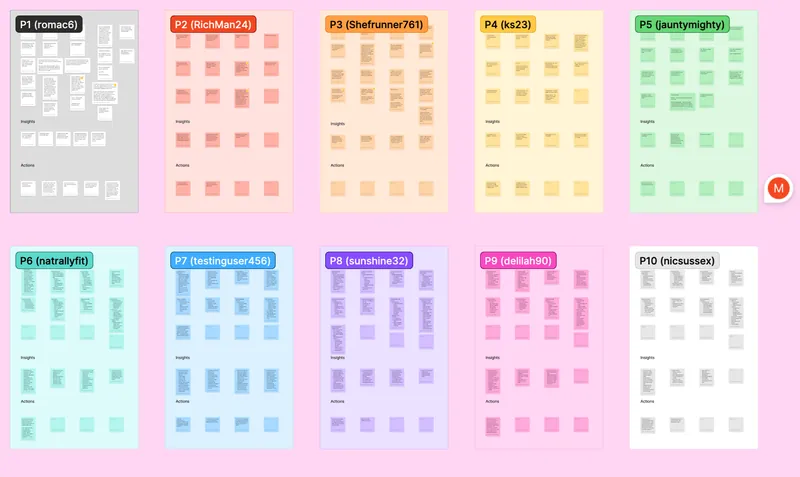
- 4 moderated virtual interviews conducted with 6–12 individuals over the course of 10 months
- 1 unmoderated session conducted with 12 participants to test a prototype
- Participants were a mixture of segments, genders, ages, occupations and household incomes, including people who had recently switched and people nearing the end of their contract
Key findings
A useful tool in the app
A tool like Bill Switcher was praised as it adds value.
I like how it’s laid out
Participants liked the visuals of the UI and praised it for its simplicity.
I trust my bank
Although a third party is involved, participants trusted their bank.
Hesitance towards ApTap
The involvement of a third party was questioned and participants asked whether they were genuinely getting a good deal.
It shows me everything I need to know
All of the information participants needed, and liked to know, was surfaced early and clearly.
How do I know if I’m getting the best deal?
What opportunity was identified?
- Customers have a predominantly transactional relationship with the bank.
- There are missed opportunities with bill switching that the bank could take advantage of to claim a portion of competitors’ market share.
- The utility bills landscape is changing every day with opportunities arising frequently, but banks are not tackling this.
How did you come up with ideas to solve the problem?
As part of a large organisation, the overarching propositions are fed to a delivery team like mine. The what is already decided for us. The how is the way we decide as a design team to tackle this. We ran a Design Sprint (opens in a new tab) as a way to quickly ideate the how behind the what.
What are the objectives and key results?
To help LBG customers switch and save money on utility bills by going through the Lloyds mobile app, as opposed to going via mobile browser (the as-is solution).
How might we…
Provide a deeper relationship with our customers that makes it clear we value their custom?
Leverage the data, resource, and customer base to create a proposition that is valuable to customers?
Personalise deals to customers to offer them the best deals in the market?
Use the bank’s size and influence to negotiate deals with third-party providers to provide the best deals for customers?
Design principles
-
Helpful

Tell users why we need the information we ask for
Customers need timely, helpful and clear information to make an informed decision.
-
Honesty

Clarify the relationship Lloyds Bank has with ApTap
Explaining to customers the relationship between Lloyds Bank and ApTap to dispel any doubt they may have about it.
-
Context

Give me the context I need to fully understand
Tell me why you need information from me so I know what it’s for, then I can make a decision with confidence and trust the service more.
Service mapping
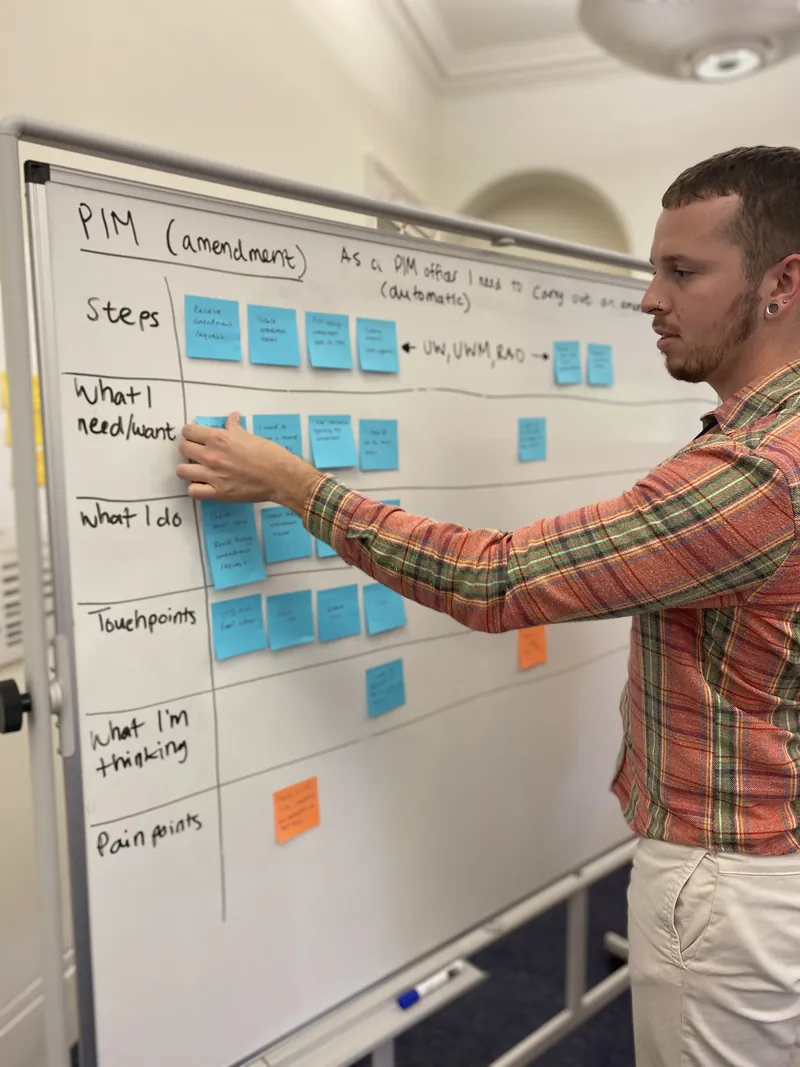
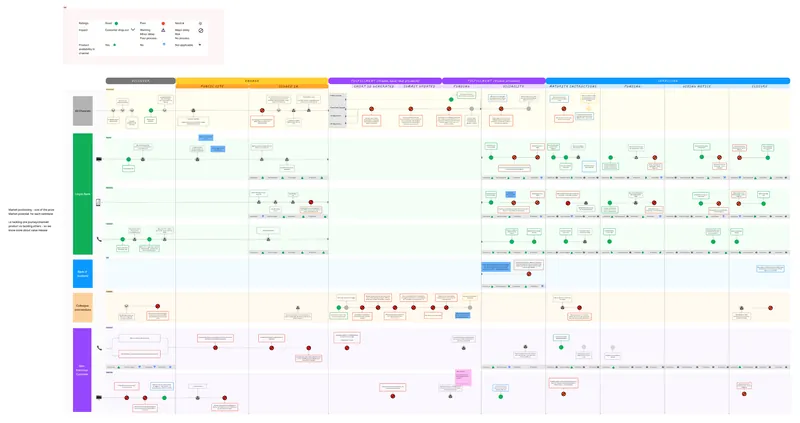
I created a service blueprint: an as-is map of the current tech, architecture, data, users and their pain points, laid out chronologically and interconnected. It helped identify UX pitfalls, commercial opportunities, decision points, and system constraints.
V1 release: native entry point, web servicing
To provide business value early, we decided the first release would be a native entry point that takes customers to the ApTap end-to-end journey via the mobile browser.
- Status
- Deployed July 2025
Screen recording of the native entry point in the Lloyds app handing over to the ApTap web journey. No audio.
Business impact of V1 release*
- conversion rate of customers opening the broadband checkout and committing to switch
- 20.22%
- confirmed sales of broadband, energy, mobile and SIM deals since the September 2024 launch
- 1,737
- total saved by broadband customers, comparing their previous bill with their new one
- £260,550
*Accurate as of March 2026
Ideation
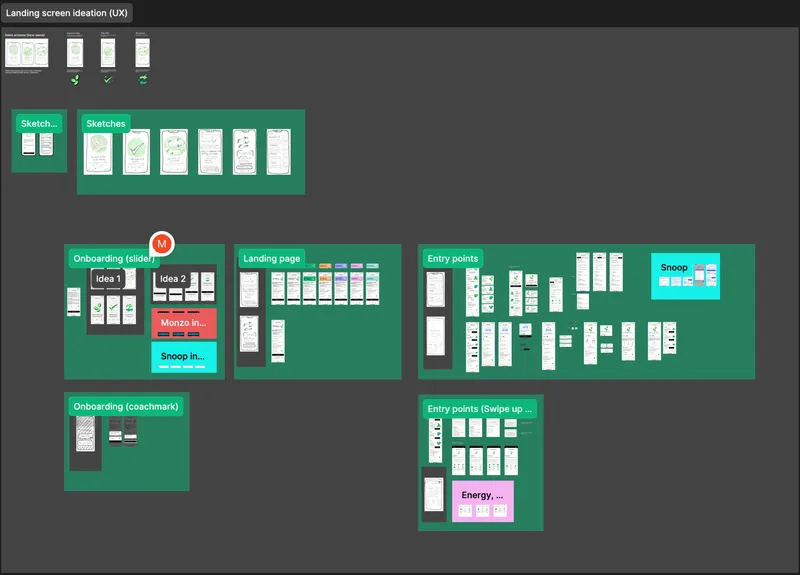
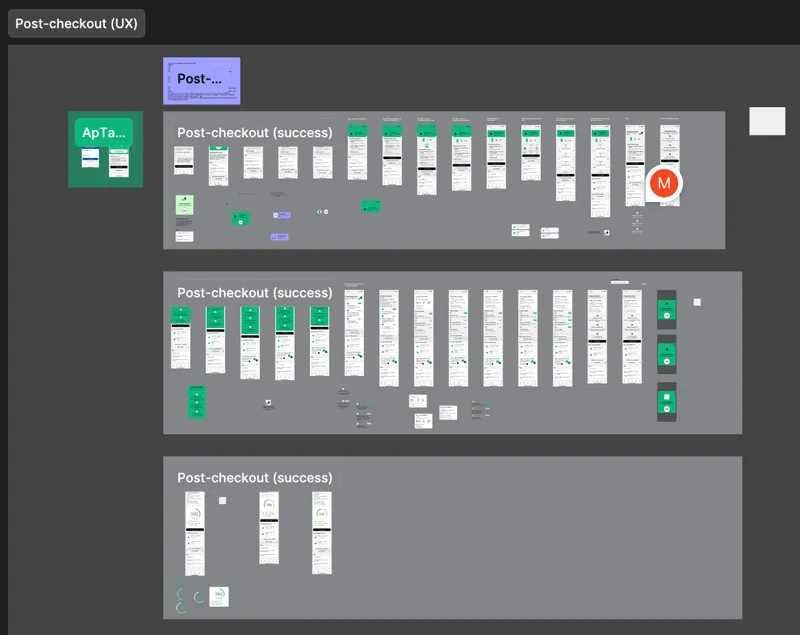
I began with quick pencil-and-paper sketches to rapidly explore ideas. My initial focus was on onboarding and first-touch screens, loosely outlining the key steps in the user journey.
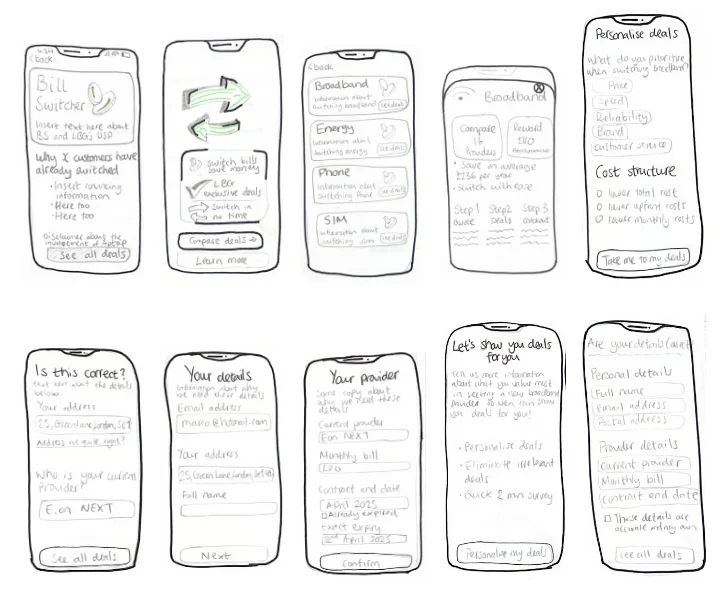
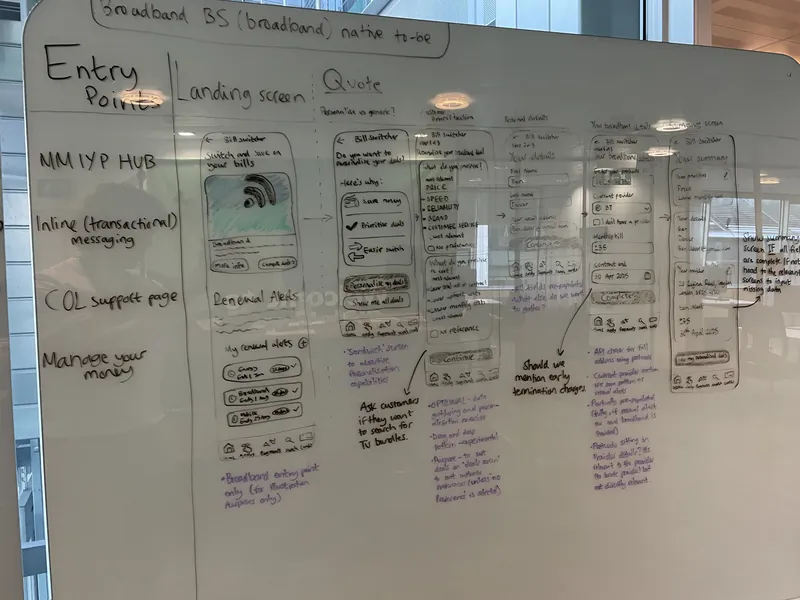
Next, I rapidly created high-fidelity screens using Cancara design system components. The system’s flexibility, ease of use, and availability made it just as quick to test as low-fidelity versions. I explored early ideas for the landing and onboarding screens.
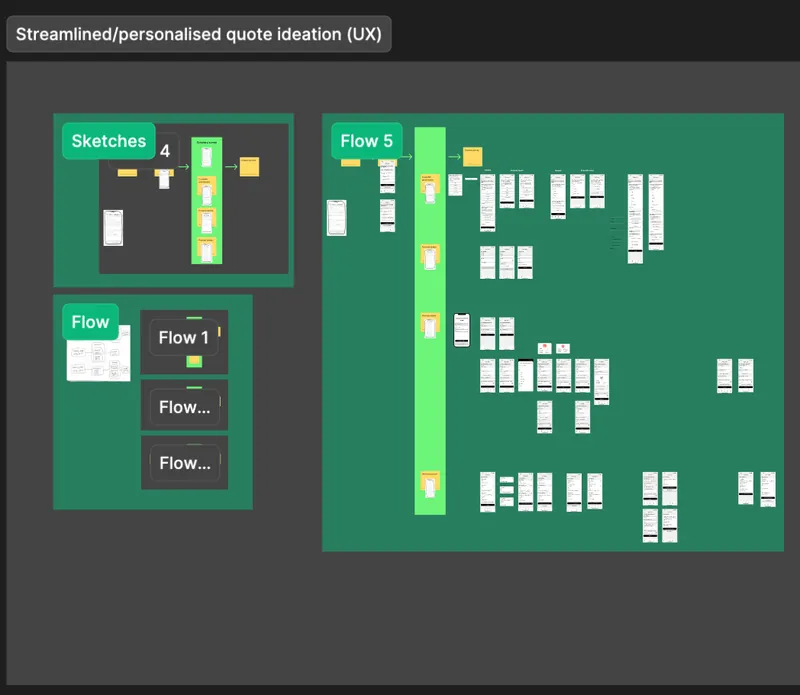
Rather than pushing customers into deals immediately, I created a split journey that lets users personalise their quote by giving more information.
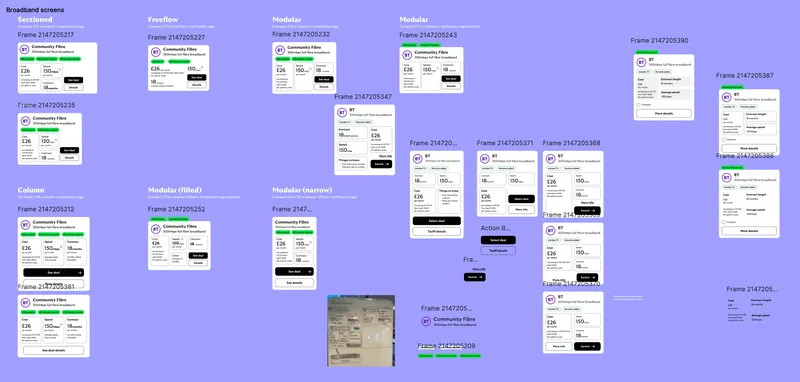
I experimented with the high-level deal card users see when browsing broadband deals. Identifying and presenting key information at this level was the priority, including designing for scalability when adding other services such as mobile, SIM and energy.
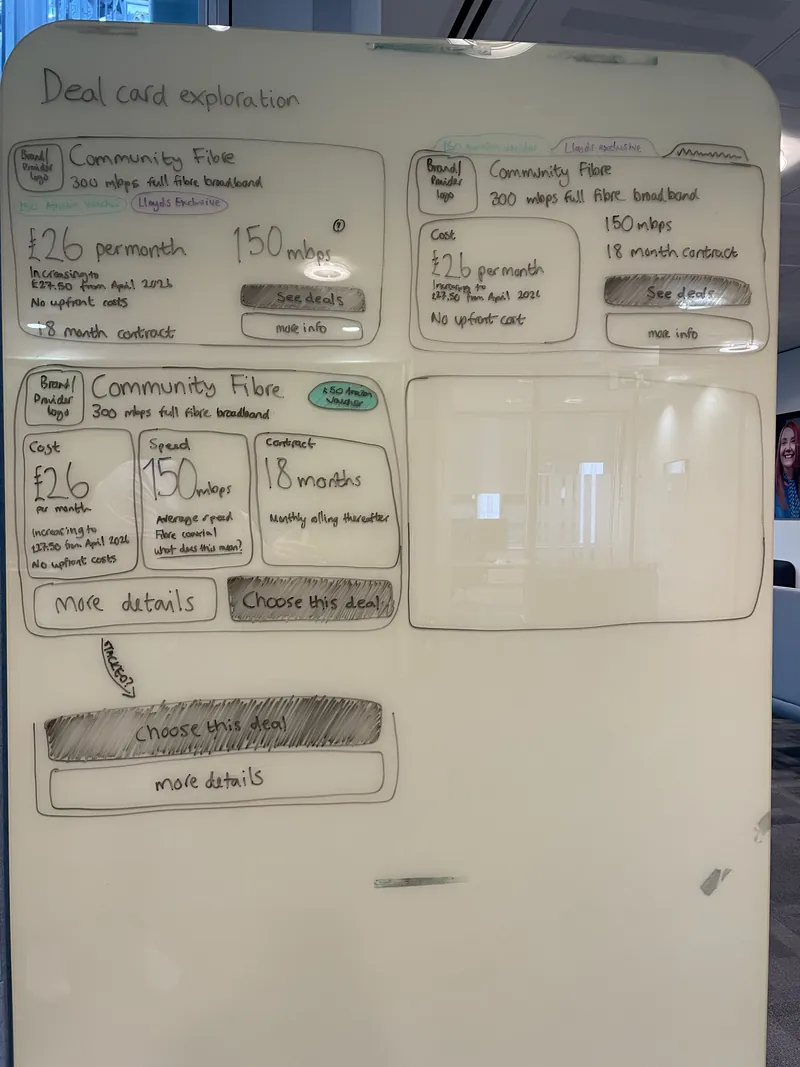
Hierarchy was the biggest challenge when designing the all-deals screen. Positioning the high-level deal card, sorting and filtering, and other calls to action and text was the priority.
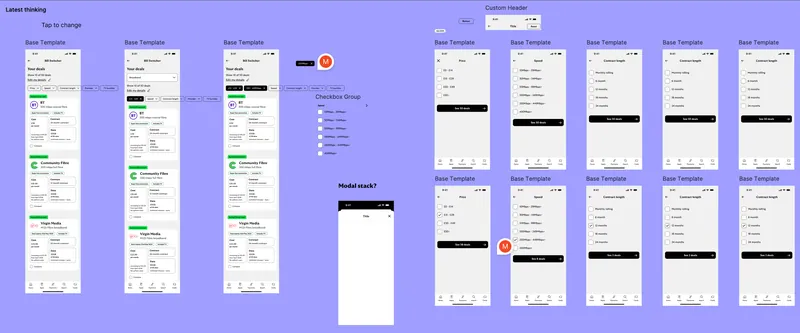
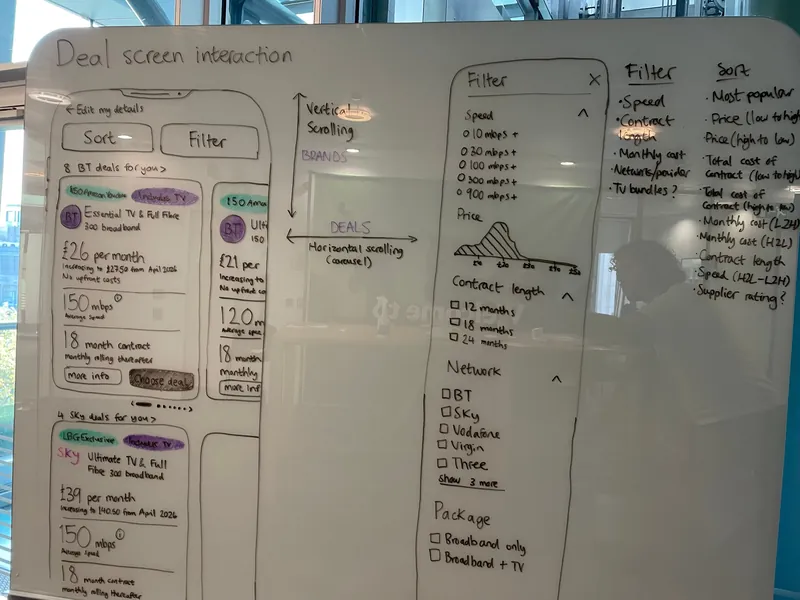
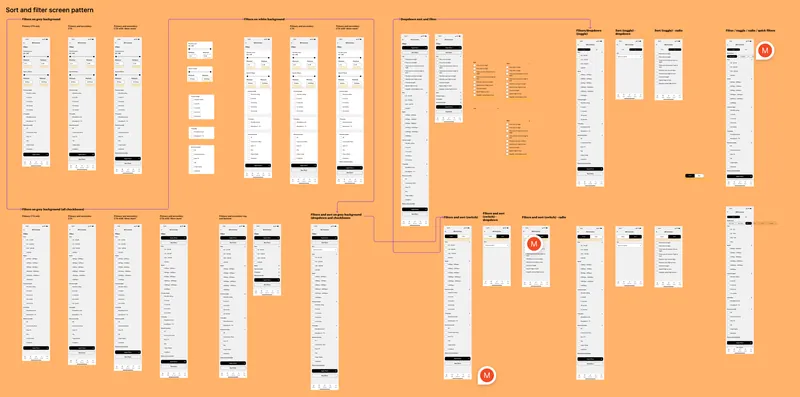
Once the hierarchy of the all-deals screen was decided, I defined the sort and filter options, benchmarking against competitors’ functionality.
Once a user had browsed the available deals, I designed the checkout, making sure business, third-party, data and customer requirements were met in a logical way that matches users’ expectations.
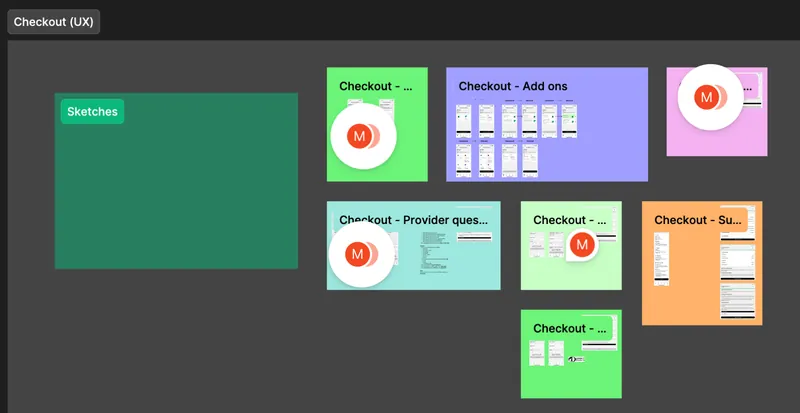
After the checkout, I designed the onward journey: an acknowledgement of the switch, progress tracking, a feedback survey and calls to action leading to other bill-switching journeys.
V2 release: renewal alerts
As an extension of the initial entry point, we released more value early to stay agile, delivering commercial and customer value while we built the fully native journey.
- Status
- Deployed September 2025
Screen recording of a customer signing up for a broadband renewal alert. No audio.
Business impact of V2 release*
- customers have signed up to receive a renewal alert
- 315
- of customers have signed up to receive a renewal alert
- 12%
- saved by customers from out-of-contract pricing
- £9,932
*Accurate as of March 2026
V3 release: end-to-end journey
A full end-to-end native experience for customers to switch their bills and save money, built with the LBG Cancara design system.
- Status
- Deployed December 2025
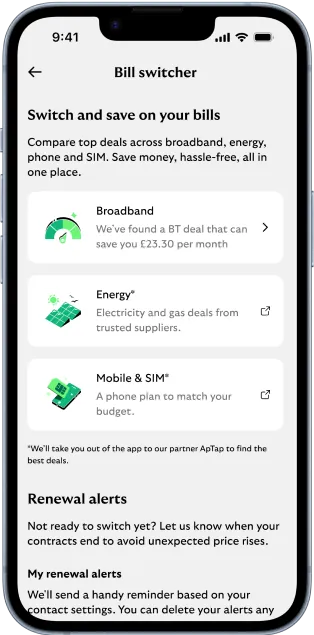
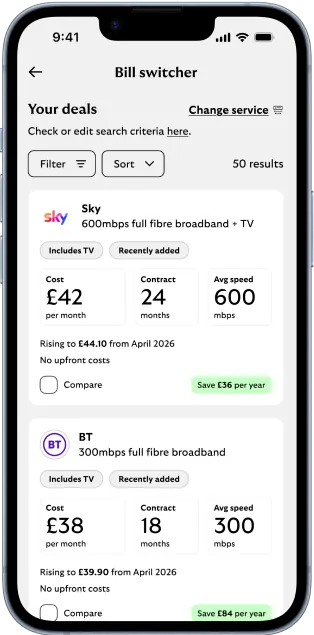
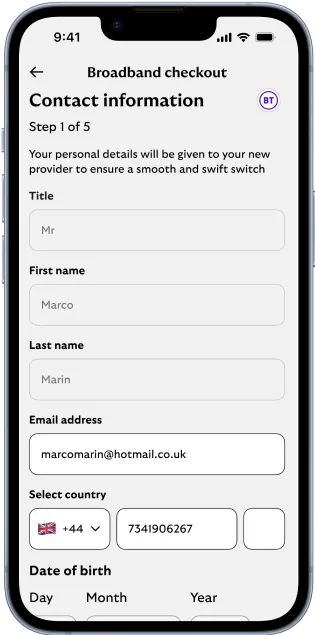
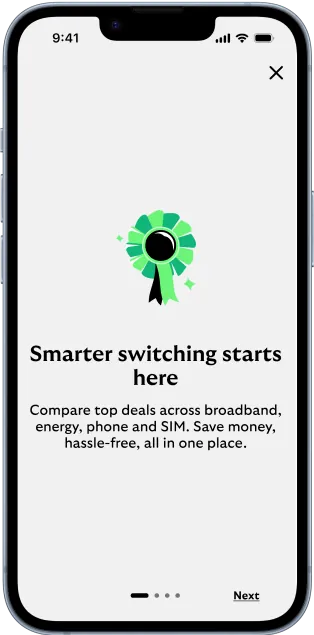
Screen recording of the full journey, from the app home screen through comparing deals to completing a switch. No audio.
Business impact of V3 release*
- customers have viewed the ‘all deals’ screen
- 404k
- confirmed broadband sales since the MVP launched in December 2025
- 18,180
- total saved for customers, comparing their previous utility bill with their current one
- £272,700
*Accurate as of March 2026
What did I learn from this experience?
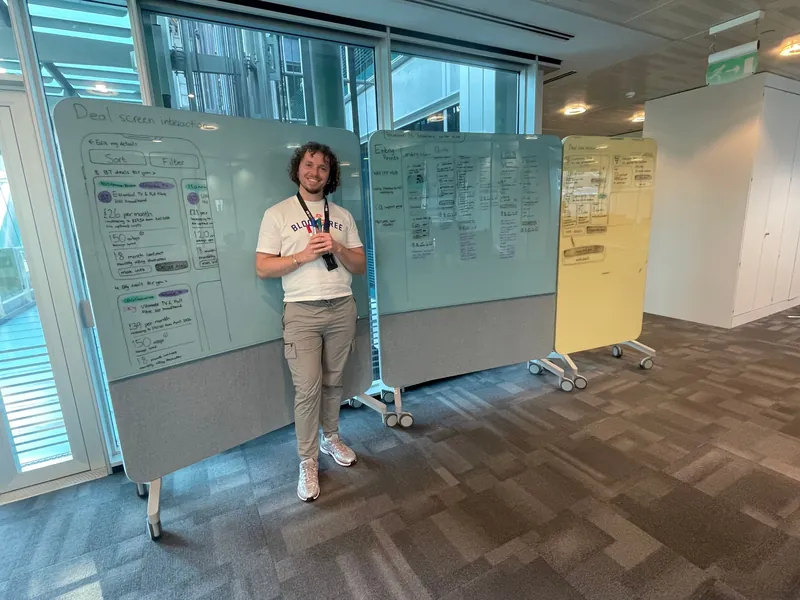
0–1 projects are where I thrive
Greenfield opportunities at big organisations can lead to more camaraderie and motivation, as we all know as much as each other and share a goal. These projects motivate me most and make me feel most proud.
Releasing incremental value often
Releasing value early and often is the spirit of agile. I balanced customer needs with business needs and made strategic releases before the end-to-end journey. Doing so created more compelling conversations with stakeholders, helped get buy-in and showed real-time performance data.
Identify requirements early
Make sure the senior leadership team and the respective tech, data, and business teams have identified and agreed clear requirements early on. Then make sure key stakeholders have agreed the scope of work, to better manage expectations.
Allow extra time as a buffer
When story-pointing tasks in Jira, insert a 10% buffer into each sprint, as things never go exactly to plan. Requirements, project resources and even timelines can change, and a buffer helps absorb this.